Hitler's First Hundred Days by Peter Fritzsche
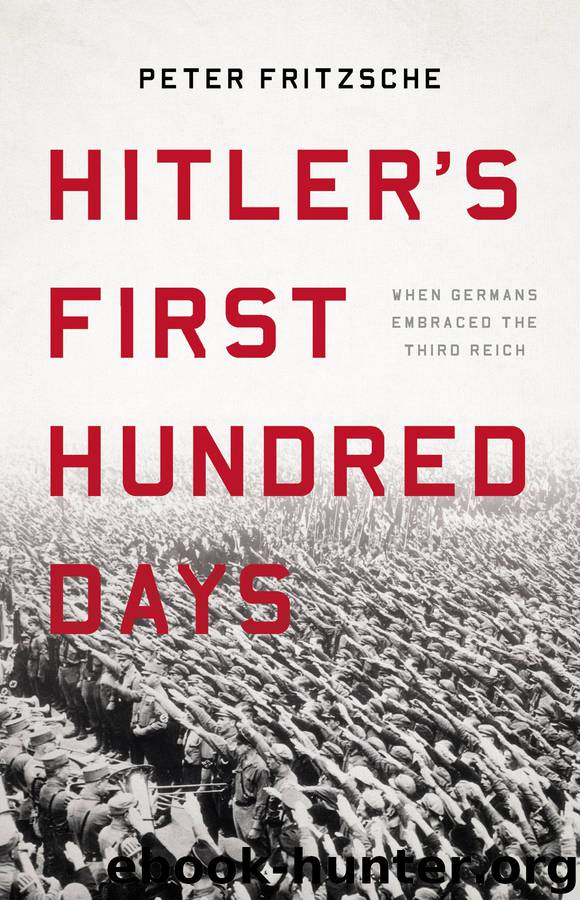
Author:Peter Fritzsche
Language: eng
Format: epub
Publisher: Basic Books
Published: 2020-03-16T16:00:00+00:00
WHEN KARL DÜRKEFÄLDEN stood at the window watching his neighbors assemble under Nazi banners on the Day of National Labor, he was witnessing the final act of a drama in which millions of Germans had taken part over the course of one hundred days. He described this drama as an Umstellung, a reorientation or adjustment that he attributed first to sheer opportunism, then also to heartfelt belief. It was one that people examined in diaries and debated around the kitchen table, that they experienced on the streets when Nazis forced mayors to capitulate and pastors to ring church bells in the party’s honor. They could hear it on the radio that broadcast the cheering crowds at Hitler’s rallies, and they could see it in the movies that replayed the struggles and rallies—the experiences—of becoming a German in the Third Reich. Let’s go to the movies.
The 1933 film Hitlerjunge Quex retold the events leading up to the “martyrdom” of a young Nazi, modeled on fifteen-year-old Herbert Norkus, who had been stabbed to death by the “Commune” on a Sunday morning on Zwinglistrasse in Berlin’s proletarian Moabit district in January 1932. It featured the famous, rough-and-ready actor Heinrich George, who had long been regarded as a leftist. George the actor and Papa Völker—the character he played—both represent telling cases of conversion to Nazism.
Heinrich George. “I ended up getting this mammoth thing of a man,” recalled the actress Berta Drews, who married George in 1931. One scholar took the measure of George with flurries of words. As an actor, George appeared as “a big-shouldered, earth-bound guy; a powerful block-like gnome; a rough, fatty enormous fellow; a brutal man-beast; a gorilla with long clasping arms; a colossus; a giant, broad as a rook; a spooky fiend; a gloomy hulk of meat; a golem with gigantic shoulders; a bearish Titan; a primal force, thick, bloated, stocky, short-necked, massive and broad, and still a sensitive nature.” On stage, “he moves to the uttermost, limping, scuffing, hobbling, pacing, stomping, prancing, careening, fluttering through the room, running, swinging his weight, hopping, marching, lurching, parading, strutting, scurrying, crawling, tottering.” Born in the Baltic seaport of Stettin, he spoke in a familiar Prussian dialect that appealed to his Berlin audiences. His speech could be “snarling, deep, earthy, terse, tyrannical, razor-sharp, blustery, soldierly, harsh, intemperate, imperious, commanding, broken-up, frightened, vulnerable, brusque, sorrowful, and tender” and also “cold, biting, brutal and raw, panting, flirtatious, boastful, twangy, joking,” as well as “affectionate, childish, simple-hearted, compassionate, wonderfully lyrical, and gentle.”65
Heinrich George played Butch, the jailhouse ringleader, in the German version of the 1930 Hollywood movie The Big House, which had made a star of Wallace Beery. A tower of strength, he was cast as the indomitable Émile Zola in Dreyfus, Richard Oswald’s 1931 film in which the republican hero appealed to “students, artists, workers”—young people—to rekindle the love of freedom and to purge themselves of the childish superstitions of anti-Semitism and the seductions of tyranny, a message from Paris in the late 1890s very much relevant to Berlin in the early 1930s.
Download
This site does not store any files on its server. We only index and link to content provided by other sites. Please contact the content providers to delete copyright contents if any and email us, we'll remove relevant links or contents immediately.
Fanny Burney by Claire Harman(26602)
Empire of the Sikhs by Patwant Singh(23084)
Out of India by Michael Foss(16853)
Leonardo da Vinci by Walter Isaacson(13336)
Small Great Things by Jodi Picoult(7137)
The Six Wives Of Henry VIII (WOMEN IN HISTORY) by Fraser Antonia(5514)
The Wind in My Hair by Masih Alinejad(5095)
A Higher Loyalty: Truth, Lies, and Leadership by James Comey(4959)
The Crown by Robert Lacey(4814)
The Lonely City by Olivia Laing(4801)
Millionaire: The Philanderer, Gambler, and Duelist Who Invented Modern Finance by Janet Gleeson(4478)
The Iron Duke by The Iron Duke(4354)
Papillon (English) by Henri Charrière(4273)
Sticky Fingers by Joe Hagan(4197)
Joan of Arc by Mary Gordon(4109)
Alive: The Story of the Andes Survivors by Piers Paul Read(4031)
Stalin by Stephen Kotkin(3965)
Aleister Crowley: The Biography by Tobias Churton(3640)
Ants Among Elephants by Sujatha Gidla(3467)
